Notes · Sep-14 2026
Money shows up before the block does
A deposit to an exchange is a transaction like any other: it is broadcast, it waits in the mempool, and some minutes later a block confirms it. Over the seven days to Sep-12 2026, 93.6 % of the 49,781 confirmed exchange transfers our map recognises — 46,609 of them — were sitting in the mempool before their block. The day-clustered 95 % interval runs from 91.8 % to 95.1 %, and no single day fell below 89.0 %. Among the transfers seen early the median lead was 7.5 minutes, and one in ten waited longer than 25.5 minutes.
That lead is the whole point of the "arriving now" window on the netflow page: it counts coins on their way to an exchange before any block has printed them. By coins, 93,910 of the 101,323 BTC that arrived over the window (92.7 %) were known before the block; for arrivals of 100 BTC and more it is 201 of 219 (91.8 %), median lead 7.8 minutes.
What is ours and what is not. The clock is not ours: first sight comes from a public mempool relay's feed, and most of the lead is the wait for the next block, which every mempool watcher shares. What is ours is the tagging — the map of exchange wallets that turns a transaction in the queue into a deposit to a named exchange, checked address by address against our own node's confirmed tape. The share counts transfers, not coins, and the denominator is what our map sees, not every exchange transfer on the network.
Honesty lines, dated. The snapshot feed behind this measurement degraded on Sep-11 2026, so the seven-day number is printed with its date and not quietly rolled forward. Since 2026-09-12 14:45Z a second, live capture runs on a websocket; on its first evening (2026-09-12 15:00–23:00Z) it had seen at least 98 % of the on-chain exchange events of that window — 1,578 of 1,595 at the four exchanges where anything was missed, 100 % at the other four — and its misses were transactions already waiting when the capture started. On the longer history, 2026-07-13 to 2026-09-10, 92.7 % of 506,689 arrivals were seen first, median lead 7.4 minutes. All three numbers stand on the two pages next door, each with its own date.
What we measure next: a full month of the live capture, then the same two numbers again — seen-first share and median lead — on 2026-10-14, and whether the lead moves with how crowded the mempool is.
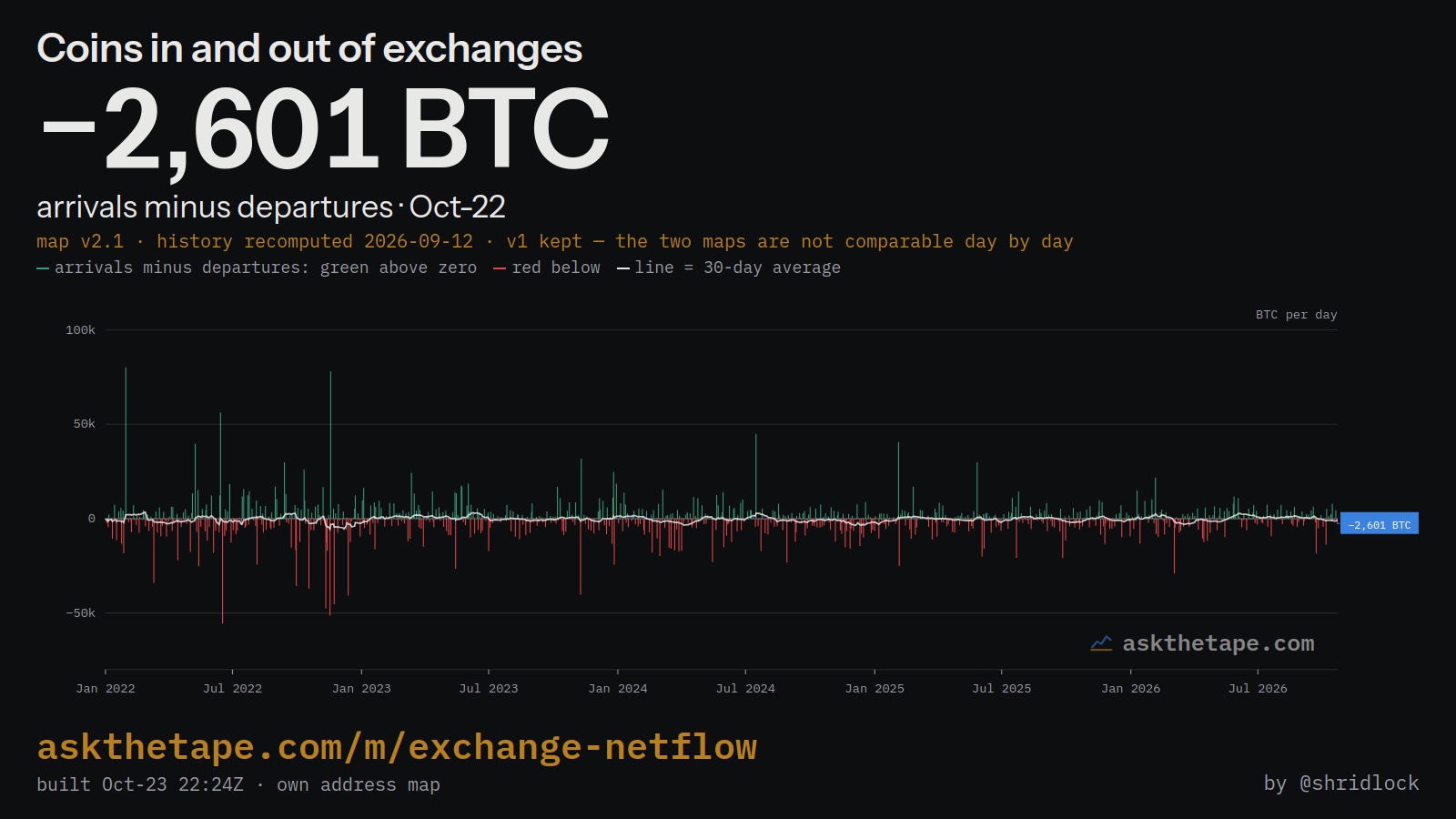
We grade this on 2026-10-14: re-measure the seen-first share and the median lead on a full month of the live capture, and print both numbers whatever they are
Built Oct-23 2026 21:59Z · all notes · RSS · all metrics